
A treasure trove of learnings
Or what have I learned in 2025, sharing now, because I won't learn anything in December, anyway...

Today, I’d like to summarize 2025.
The year is ending, not to mention I had a very busy weekend (St. Nicolas’ Eve, or something like that - y’know, kids and presents) and did not have time or energy to think of something better ;-) So I checked the entire year of my issues to check what I learned this year, and decided to share these with you, as I do each year.
This e-mail will get clipped, because it’s so long ;-)
So, here’s what I learned this year!
From other gamedevs
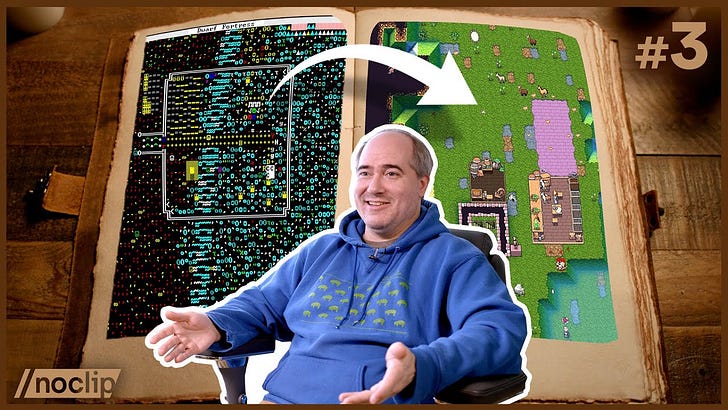
If there’s one platonic love for games I have is that for Dwarf Fortress. It is as intimidating as it is fascinating. And yet, it shows how to deliver! By starting from the simplest possible look of the final product.
Dwarf Fortress is the best lesson of what a MINIMUM VIABLE PRODUCT (MVP) looks in games.
We’re used to think about economy when we think about money, but what about experience points? In a way many games are “printing money” as much as they’re “printing experience points”. Hence my thinking: maybe experience points should also be considered an economy. Less printing money! More inflation! :D

Solo game developers will most probably not do diverse projects. Hell, big devs sometimes don’t. Embrace the power of iteration. You might get far!

Everybody has ideas, but the problem is - not every idea is the some type of idea. And once you learn what kind of idea your idea is, you’ll also learn what other ideas do you need. Ideas can complement each other! Use it to your advantage!

Did you know? You can divide your games into minigames! Makes them easier to test and develop. Hell, old turn-based J-RPGs in a way did that all the time ;-)

Ayayay, AI!
I made Pong using an LLM and three different game frameworks (as game frameworks are born to be used with LLMs) and realized it’s much easier than I think. The only reason why I haven’t made a game so far is that I still want to learn my tool and learn how to break down a game. Which is slowing me down, unfortunately…

I should go the route of Pieter Levels aka Levelsio, as he just vibe coded a Flight Simulator!

Becuase, I realized, vibe coding will most definitely increase impostor syndrome. And it does, for some.
But I still tried vibe coding multiple times and learned something about working with it:

Seeing what AI is capable of today, sometimes I want to really go all in and just do everything with AI. Graphics, sounds, etc. What’s stopping me? Ostracism and witchhunts. But I still think graphic-makers and crew can benefit from AI:

I also realized about all the falsehoods I believe that are slowing me down. Did not figure out how to get past it, but at least I know my enemy!

My current favorite game framework - Bevy!
Bevy has been on my radar for some time now. Not only because of the ECS pattern and the fact that it is written in Rust (another shiny object on my list). But after watching a clip of someone introducing new people to Bevy I realized that this framework is a game changer for me specifically. After every tutorial I play around with the code in order to structure it as I see fit. For readability, reusability, and so on. But Bevy helps you even with that, making your code poetry to read.

And speaking of ECS - here’s my introduction to the pattern:

Good thing I picked a battle-tested solution, because I realized that going for the shiny object has its traps:
Also, I created a Notion template for all you people who want to better prioritize your backlog:
https://mariuszklimek.gumroad.com/l/gaming_backlog_manager
It will really help you! Trust me ;-)